I built a second brain that runs on Claude Code.
A personal knowledge management system that captures every conversation, transcript, and note into an Obsidian vault, then curates it into a wiki an LLM can read directly. Drop files in, run /ingest, ask the wiki anything with /query. A nightly cron keeps it current while you sleep.
The pattern, end-to-end
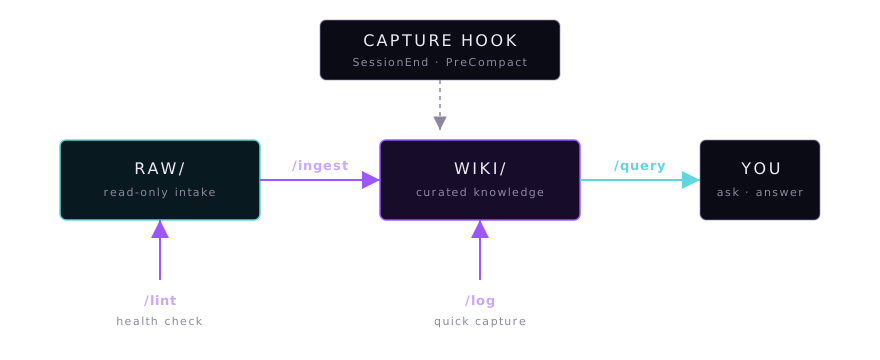
The system is a working implementation of the LLM Wiki pattern Andrej Karpathy has talked about. Source notes stay raw and untouched; a curated layer above them does the synthesis, the linking, and the attribution. Every claim points back to where it came from.
RAW IS RAW
Conversations, transcripts, articles, notes — every source lands in raw/ and never gets edited again. It's the audit trail.
WIKI IS CURATED
Claude promotes raw sources into structured wiki pages with frontmatter, cross-links, and source attribution. One idea per page.
FEEDS ITSELF
A capture hook saves every Claude Code session into raw/. A nightly cron runs /ingest and /lint at 02:00.
Two domains, one rule
The vault has exactly two top-level concerns: read-only intake and curated output. Everything else — agents, content drafts, journal — is optional scaffolding you grow into.
second-brain/
├── raw/                       # read-only intake — never edited by hand
│   ├── claude-exports/
│   │   └── auto/             # written by the SessionEnd hook
│   ├── chatgpt-exports/
│   ├── articles/
│   ├── notes/
│   ├── voice-memos/
│   └── youtube-transcripts/
├── wiki/                      # Claude's domain — curated output
│   ├── index.md              # master catalog
│   ├── log.md                # append-only activity log
│   ├── concepts/
│   ├── projects/
│   └── people/
├── agents/                    # optional persona files
├── content/                   # optional drafts
└── .claude/
    ├── settings.json         # hook config
    ├── commands/             # /ingest /log /query /lint
    ├── hooks/                # capture-session.py
    └── scripts/              # nightly-ingest.ps1 / .sh
The contract Claude reads on every session
One file at the vault root — CLAUDE.md — defines structure, frontmatter rules, link syntax, and style. The same six frontmatter fields show up on every wiki page.
---
title:        "Home Server"
type:         concept          # concept | source-summary | project | person
sources:
  - raw/articles/2026-04-18-proxmox-setup.md
  - raw/claude-exports/auto/2026-04-19-103044-session-end.md
related:
  - "[[proxmox]]"
  - "[[atlas]]"
created:      2026-04-18
last-updated: 2026-05-01
---

# Home Server
## Overview
2-paragraph summary of the home-server stack...
## Key Points
- Proxmox 8.2 on the [[atlas]] machine, three VMs running...
## Sources
- (source: articles/2026-04-18-proxmox-setup.md)
FRONTMATTER · 6 FIELDS
title, type, sources, related, created, last-updated. /lint catches you the first time you forget one.
WIKI-LINKS · NATIVE OBSIDIAN
Cross-link with [[slug]]. Open the vault in Obsidian and the graph view + backlinks panel come for free.
Four commands. The whole loop.
Each command is a Markdown prompt at .claude/commands/. Drop them in, type the slash, Claude does the rest.
The system feeds itself
A single Python file, ~150 lines, hooked to Claude Code's SessionEnd and PreCompact events. Every session you run lands in raw/ as a Markdown snapshot.
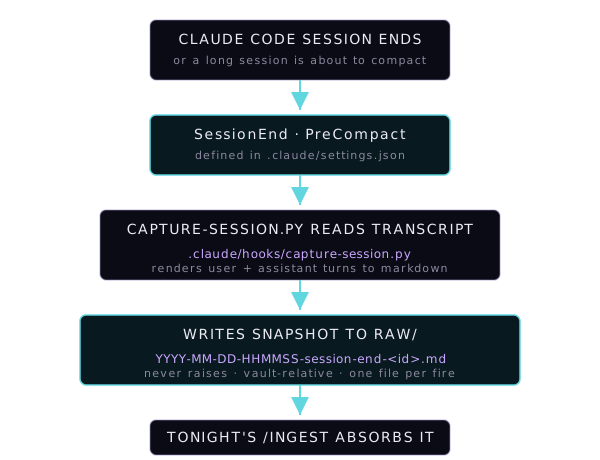
# Fires on SessionEnd and PreCompact. Never raises.
# One file per hook firing — vault-relative, local I/O only.
def main():
    payload = json.loads(sys.stdin.read())
    transcript_path = payload.get("transcript_path")
    event = payload.get("hook_event_name", "unknown")

    vault_root = Path(__file__).resolve().parent.parent.parent
    out_dir = vault_root / "raw" / "claude-exports" / "auto"
    out_dir.mkdir(parents=True, exist_ok=True)

    messages = read_transcript_jsonl(transcript_path)
    rendered = render_transcript(messages)

    now = datetime.now()
    filename = f"{now:%Y-%m-%d-%H%M%S}-{event.lower()}-{short_id}.md"
    (out_dir / filename).write_text(frontmatter + body, encoding="utf-8")
Lock · snapshot · run · report
A clean PowerShell wrapper (or bash equivalent) that runs /ingest then /lint at 02:00 every night. Concurrency-locked, snapshots wiki/ first, writes a structured status JSON.
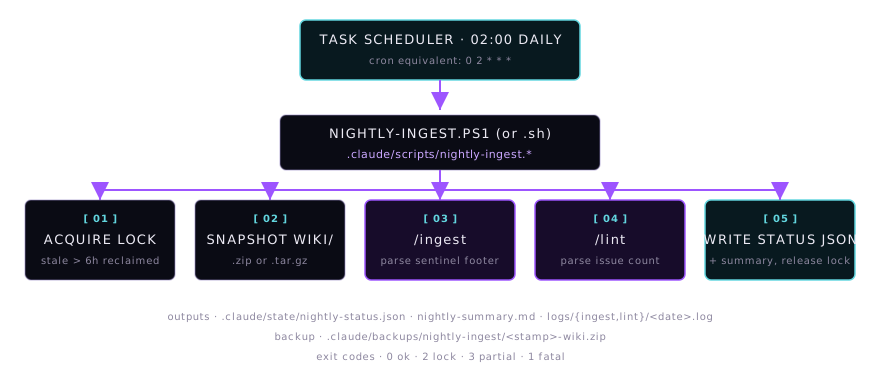
{
  "startedAt":   "2026-05-02T02:00:00Z",
  "completedAt": "2026-05-02T02:04:18Z",
  "vault":       "/home/you/second-brain",
  "overall":     "ok",
  "backupPath":  ".claude/backups/nightly-ingest/20260502-020000-wiki.zip",
  "ingest": {
    "status":    "ok",
    "processed": 5,
    "created":   3,
    "updated":   4,
    "remaining": 12
  },
  "lint": { "status": "ok", "issuesFound": 0 }
}
Six steps to a working second brain
30–45 minutes from git clone to a vault that captures itself. Full templates and prose in GUIDE.md.
SCAFFOLD THE VAULT
Single shell command creates raw/, wiki/, agents/, content/, journal/, .claude/ — and the suggested raw/ subfolders.
Read step 1 →INSTALL CLAUDE.MD
Copy the conventions template to the vault root. Edit Section 4 (Domain Context) for your life.
Read step 2 →INIT INDEX + LOG
Two seed files — index.md (catalog) and log.md (activity). Both grow as you use the system.
Read step 3 →INSTALL THE COMMANDS
Drop /ingest, /log, /query, /lint into .claude/commands/. Sanity-check with one test source.
Read step 4 →WIRE THE CAPTURE HOOK
capture-session.py + a SessionEnd block in settings.json. Verify by ending a session and looking in raw/claude-exports/auto/.
Read step 5 →SCHEDULE THE CRON
Run nightly-ingest.ps1 -DryRun to verify, then register the daily 02:00 task. Bash + cron equivalent included.
Read step 6 →Everything required, nothing exotic
Plain Markdown, a Python script, a PowerShell or bash wrapper, and Claude Code. No cloud, no database, no API keys beyond Claude.


BUILD ONE OF YOUR OWN
The full setup walkthrough, drop-in templates, and lessons learned live in the repo. Fork it, follow GUIDE.md, and message me when something breaks — feedback sharpens the templates for the next person.